


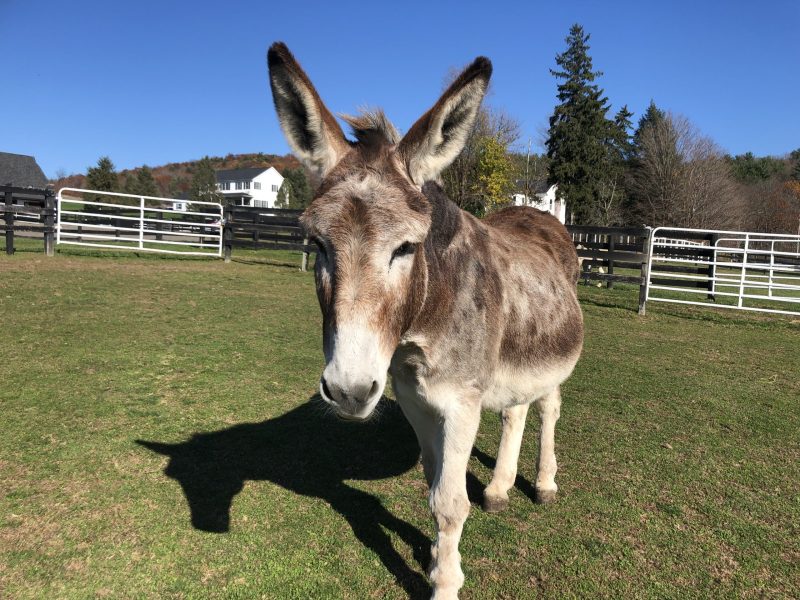
One of the best things about walking around an equine sanctuary is getting to take in the sights and sounds of nature. One of the funniest sounds you can hear is the loud ‘hee haw’ of a donkey. Even if the loud bray catches us off guard, it’s still music to our ears and makes us think about all the reasons we love donkeys.
Great Protectors
When deciding between Fight or Flight, donkeys are less flighty than horses. Donkeys tend to stand their ground and fight when threatened. They’ll defend their territory, which means they also tend to defend other animals they are bonded with.
While donkeys are social creatures like horses, they don’t need as many friends. Donkeys can bond with just one other equine and live as a pair. Wild donkeys, or burros, can live in herds but since they don’t form strong social bonds, wild herds often break up and reform with new members regularly. When a donkey bonds with another equine, it’s a serious relationship. Separating a pair can have negative effects on donkeys, including stress, pining behavior, and loss of appetite.
Safe, Not Stubborn
Because donkeys don’t tend to run away from danger, they can sometimes be seen as stubborn, especially when they refuse to work. Donkeys will stand their ground and refuse to move as they assess the situation to determine if it’s safe. Their initial refusal is due to self-preservation, not stubbornness.
Make Some Noise
We mentioned how much we love hearing a donkey bray. We also find it fascinating how their signature sound is unique among other equines. A bray comes from vocalizing while both inhaling and exhaling, which is an ability that horses and zebras don’t have. The “hee” occurs during air intake, while the “haw” comes during air outflow. Even though they have the same vocalization, every donkey has their own individual bray.
Cool Ears
A donkey’s large ears are one of the physical features that sets them apart from other equines. The large size heightens their sense of hearing, so donkeys can pick up calls and sounds from miles away. Also, their ears help them stay cool during high heat because the larger surface area helps donkeys expel their internal heat at a high rate.
Donkey Hybrids
Donkeys are key players in many of the world’s hybrid creatures. Since they’re closely related to horses and zebras, they can procreate with both and have created several mixed-species animals. For example, a mule is a hybrid of a male donkey and a female horse, while the offspring of a female donkey and a male horse is called a hinny. Typically, mules are sterile, but in the slim chance a mule can reproduce, he or she can mate with a donkey or horse to create more hybrids. Donkeys can also mate with zebras. The hybrid of a male donkey and a female zebra is called a zebra hinny, a zebret, or a zebrinny. The hybrid of a female donkey and male zebra is called a zebroid, a zebrass, or a zedonk. That’s a lot of creative names!
The earliest documented donkey hybrid was the kunga, which was used as a draft animal in ancient Syria and Mesopotamia. This unique equine was the offspring of a domesticated female donkey and a captive male Syrian wild ass. They were produced at a breeding center at Nagar (now Tell Brak) and were sold or given as gifts throughout the region, where they became significant status symbols. They fell out of favor after domesticated horses and mules were introduced into the region at the end of the 3rd millennium BCE.
Donkeys have amazing memories and are extremely intelligent. They were used for work during the development of this country and played an important role in our history. However, today we consider them more as wonderful pets and companion animals. We adore these sweet, long-eared equines and thank them for everything they give to us.
This column was published in Berkshire Animal World’s August 2023 issue.