


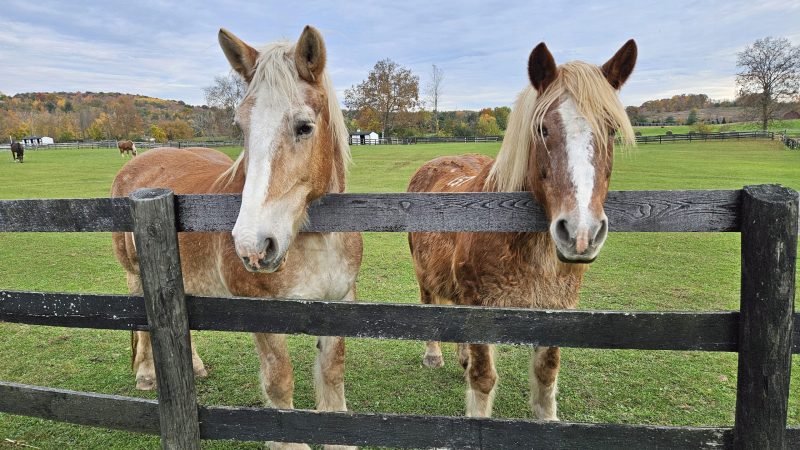
Communication is essential to developing a strong relationship between equines and their caretakers. Since horses can’t use words to tell us their mood or thoughts, we need to know how to read their body language. From the tip of their ears to the end of their tail, horses have many ways to let us know what they’re feeling.
Happy Horse
A happy, relaxed horse will stand with one resting hind leg, facing forward with ears up and a closed, relaxed mouth. Licking and chewing are also indicators that a horse is happy. When riding, it’s good if the horse’s tail is slightly raised and swings loosely.
If their head and neck are lowered, their ears are turned out to the side, their eyes are half-closed, and their lower lip is hanging low, chances are they are dozing. This indicates that they feel they are in a safe and comfortable environment. When approaching a resting horse, it’s important to move slowly and calmly, since the horse may be startled if you approach suddenly. Call their name or make some noise, and don’t approach until he or she turn their head to indicate that they’re paying attention to you.
Worried or Anxious Horse
If you approach a horse and they display signs of anxiousness, they could be uncomfortable with your or another person’s presence. This includes a horse standing with a raised head, ears held back or pointing in different directions, a tense muzzle with square nostrils, and tense cheek muscles. When it comes to their eyes, they could be darting back and forth, or the white part could be showing. (Arabian and Appaloosa breeds are the exception since the whites of their eyes are routinely visible.)
Sick or Hurt Horse
Signs of pain or discomfort include limping, biting at their sides, having dull eyes or pinned back ears, and other signs of general malaise, such as a sleepy, distraught facial expression.
Other signs that a horse isn’t feeling well include standing far off from a group as if they don’t want to interact with other horses, displaying a fixed stare and rigid stance, and reduced activity level. Keep an eye on this behavior so injuries or sickness are spotted as soon as possible.
Unhappy or Aggressive Horse
If an equine’s ears are pinned back to their neck, they’re unhappy with the situation. If they also have the whites of their eyes showing and their mouth open, showing their teeth, this is a warning sign to stay away. An angry or annoyed horse will also stomp, strike, or kick.
When a horse’s tail is swishing quickly from side to side or up and down, or if the tail is clamped down, this is often a warning sign that they’re about to kick or buck, and you need to heed it immediately.
Learning a horse’s body language takes time, but most importantly, over time, you will get to know and understand your horse well. Caretakers should observe how a horse’s postures and expressions change as he or she interacts with you as well as other people and animals. Before long, you’ll be able to understand the more subtle signs that their mood has changed and how to communicate with your horse in these cases.
This story was published in Berkshire Animal World’s October 2025 issue.