


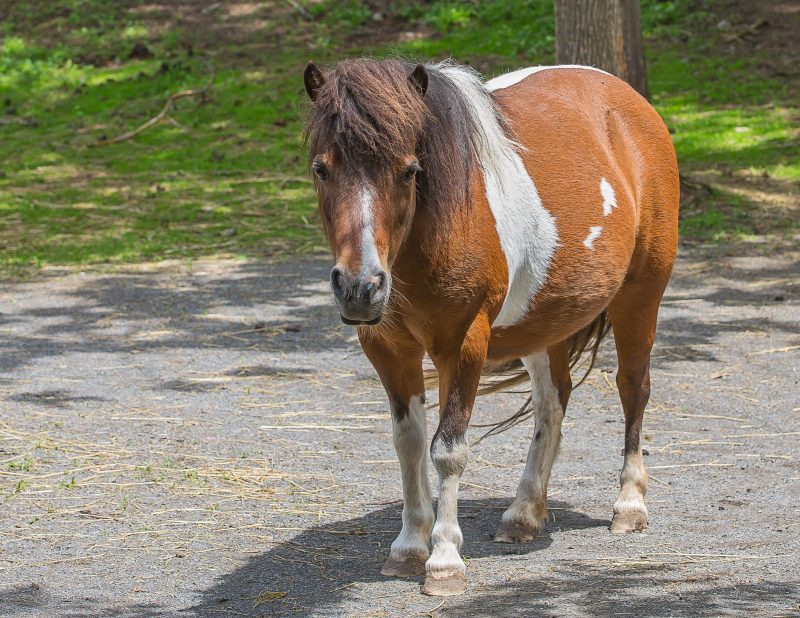
Horses come in all shapes and sizes, but don’t be fooled by those on the shorter side – They may be small, but miniature horses and ponies have big personalities! Often, though, miniature horses and ponies are mistaken for being the same type of horse, or sometimes they’re seen as just young horses. However, there are many differences between miniature horses, ponies, and standard-sized horses.
Let’s start with the fact that, contrary to a common belief, ponies are not baby horses. A young horse is called a ‘foal.’ However, the word ‘pony’ actually originated from the old French word ‘poulenet,’ which means ‘foal.’ We hope that isn’t too confusing.
Ponies, at any age, are horses that are shorter than 14.2 hands, or 57 inches. In comparison, miniature horses are classified as horses whose height is under 8.5 hands, or 34 inches. So, while still shorter than standard-sized horses, ponies are typically taller than miniature horses.
It’s not just height, though; Ponies also have different physical features. Overall, ponies are stockier and more heavily built than miniature horses, and although they are often taller, their legs are thicker and shorter than miniature horses. Ponies also tend to have thicker and shorter necks, as well as thicker coats, manes, and tails that are often much coarser in texture.
Ponies and minis also descended from different breeds of horses. Ponies were originally developed from horses of the “draft” subtype that were once common in Northern Europe. Due to the harsh climate and scarce food supply, the ancestors of modern ponies became smaller and smaller, eventually forming a new type of equine. Meanwhile, miniature horses descended from a wide variety of horse and pony breeds, including Shetland ponies. Minis originated in Europe in the 1600s and were used for work in mines due to their small size. They started to arrive in the United States in the late 1800s, where they also went to work in mines.
When it comes to behavior, ponies are generally considered intelligent and friendly, but sometimes they are also described as stubborn.
“The ponies and minis we have at the sanctuary are extremely mischievous, comical, and always amusing,” said Equine Advocates President Susan Wagner. “Some like to refer to the special attitude that small equines seem to possess as ‘ponytude’ because they can sometimes be headstrong and obstinate. However, as far as I’m concerned, that makes them even more endearing and adorable.”
Miniature horses tend to be gentle, playful, intelligent, and curious, and can be easily trained. These characteristics make them ideal companion pets, or service or therapy animals. However, owners and caretakers should not be fooled by their small size, as they need just as much care as larger equines.
Minis still need farrier care, a proper diet, and adequate space to roam and graze, as they are prone to obesity. Dental care is especially important for miniature horses because they are prone to some dental issues. This is because they still have all the teeth that larger horses do, but their heads are smaller. This proportion can impair their chewing capacity, due to teeth being overcrowded in their mouths, and lead to dental problems.
One last fun fact about ponies and miniature horses – Both tend to live longer than horses.
At the end of the day, horses of all sizes are wonderful and unique, which is what we love about them!
This column was published in Berkshire Animal World’s December 2022 issue.